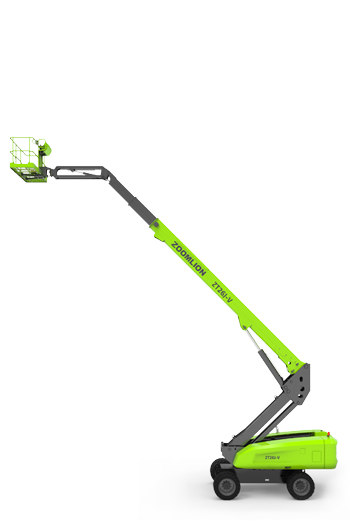
A telescopic boom lift should be selected by the geometry of the building as much as by its maximum working height. Contractors working on façades, steel structures, industrial buildings, and large commercial projects need to know where the platform must reach in relation to the machine base. A clear geometry review can help determine the required horizontal outreach, working height, clearance, and setup locations before equipment is ordered.
Read Building Geometry Before Choosing a telescopic boom lift
Start with a site drawing or elevation and mark every critical work point. Record the height of the work surface, its distance from the proposed machine position, and any horizontal offset created by setbacks, trenches, landscaped areas, or restricted zones.
Do not measure only from the building entrance. The machine may need to stand several meters away from the façade because of foundations, pedestrian routes, underground services, soft ground, or other construction activities. Each restriction changes the reach requirement.
Turn Work Points Into a Reach Envelope
Once the key points are marked, create a simple reach envelope showing minimum and maximum horizontal distances. Include regular work points as well as the farthest locations that may occur during installation, finishing, inspection, or maintenance.
Horizontal outreach should be assessed together with working height. The required combination can be more demanding than either dimension alone. OSHA states that manufacturer boom and basket load limits must not be exceeded, making the applicable machine load chart essential when planning actual positions.
Account for Obstacles and Clearance
Building geometry is rarely a straight line from ground to work point. Roof overhangs, balconies, pipes, steelwork, temporary structures, and neighboring buildings can affect the boom path. Contractors should identify both the point where the platform needs to work and the space the boom needs to move into position.
Also check overhead clearance and the surrounding work zone. OSHA guidance calls for attention to overhead objects and warns against exceeding vertical or horizontal reach limits. This is particularly important when a long-reach boom is deployed close to completed structures.
Check Platform Position, Not Boom Length Alone
A common planning mistake is to compare machines by boom length without considering the resulting platform position. A telescopic boom changes its angle and extension as it moves toward a work point, so usable reach depends on the complete operating envelope.
Platform capacity must also remain suitable at the intended position. Include operators, tools, and materials in the working load. OSHA specifically requires the combined weight of workers, tools, and materials to stay within the applicable load-capacity limits.
Match Setup Locations to Site Constraints
A machine needs enough room not only to reach the façade but also to enter, turn, position, and operate safely. Measure access gates, haul roads, turning areas, and the planned working surface before deciding where the lift can stand.
Ground conditions deserve the same attention. Check slopes, soft areas, recently filled ground, underground voids, drainage routes, and areas affected by excavation. A theoretical reach advantage has limited value if the machine cannot be positioned on a suitable surface.
Plan for Movement Between Elevations
For projects with several building elevations, map the sequence of work. Determine whether the machine can cover multiple areas from one setup or whether it must relocate between sections.
Fewer repositioning cycles can simplify workflow, but the best setup is not automatically the one with the greatest reach. A contractor should balance work coverage with travel paths, exclusion zones, delivery traffic, and coordination with other trades. This creates a practical equipment plan rather than a specification-led decision.
Evaluate the ZT26J for Large-Scale Geometry
For projects requiring substantial reach, Zoomlion Access lists the ZT26J as a diesel telescopic boom lift. Their official product specification states a maximum working height of 28.7 m, platform height of 26.7 m, and horizontal outreach of 22.1 m. Platform capacity is listed as 300 kg unrestricted and 454 kg restricted.
The published dimensions are 11.91 m stowed length, 2.49 m width, and 2.82 m height, with a gross weight of 17,400 kg. The ZT26J also has 45% gradeability, 360° continuous turntable swing, and 4WD. These specifications can be compared with site geometry and access constraints.
Use Zoomlion Access Data in the Project Brief
When discussing the ZT26J with Zoomlion Access, contractors should provide building elevations, the farthest horizontal work point, required working height, platform load, obstacle locations, setup surfaces, and access dimensions. Their team can then assess the machine against the actual operating envelope rather than a single headline reach figure.
For a telescopic aerial work platform, the published 22.1 m horizontal outreach provides an important reference, but it should be checked against the relevant load and working configuration. Contractors should request confirmation of the applicable load chart, configuration, and destination-market documentation before finalizing equipment selection.
Verify the Final telescopic aerial work platform Configuration
Before mobilization, compare the proposed machine configuration with the latest site plan. Confirm that the required work points fall within the permitted operating envelope and that the platform load remains within the manufacturer’s stated limit for those positions.
A good geometry review connects elevation, horizontal offset, obstacles, ground conditions, access, and work sequence. With those factors documented, contractors can evaluate the ZT26J specifications from Zoomlion Access more accurately and determine whether its reach suits the building geometry rather than choosing equipment based only on maximum height.