For businesses entering additive manufacturing, choosing a suitable printing technology can be difficult when equipment, materials, software, and post-processing all affect the final result. Resin 3D printing offers a practical route to producing detailed models with relatively accessible desktop equipment. Understanding how the process works, what materials require, and how to select a resin can help new users establish a more consistent workflow.
What Is Resin 3D Printing?
Resin 3D printing is an additive manufacturing process that uses liquid photopolymer resin and light to build objects layer by layer. Common resin printers use technologies such as LCD, DLP, or SLA, with the light source selectively curing portions of liquid resin according to the digital model.
Unlike filament-based printing, the material begins as a liquid rather than a solid thermoplastic. This allows resin systems to produce fine details and smooth surfaces, which is useful for prototypes, figurines, models, product-development samples, and other applications where appearance and dimensional detail matter.
How Does the Printing Process Work?
A typical workflow starts with preparing a three-dimensional model in slicing software. The software converts the model into individual layers and generates printing parameters such as exposure time, layer thickness, and lifting settings. The printer then selectively cures each layer until the complete model has been formed.
After printing, the model normally requires post-processing. Depending on the material, this can include washing away residual resin, removing supports, drying the part, and post-curing it under suitable UV light. Beginners should follow the material supplier’s instructions because processing requirements vary between formulations.
Choosing the Right Resin for Beginners
Material selection should be based on the intended application rather than simply choosing the least expensive option. Standard resins may be suitable for models where appearance and detail are priorities, while tougher formulations can be considered when the printed part needs greater resistance to impact or bending.
Colored resin can also be useful when the finished model needs a specific appearance without relying entirely on painting. However, color should not be treated as the only selection criterion. Mechanical properties, viscosity, shrinkage, printer compatibility, exposure requirements, and post-processing should also be reviewed before purchasing material.
Why Water-Washable Resin Can Simplify Post-Processing
Post-processing can be one of the less familiar stages for beginners. Water-washable materials are designed to allow printed models to be cleaned with water rather than requiring alcohol-based washing as part of the normal cleaning process. This can simplify the workflow, although users still need to handle uncured resin responsibly.
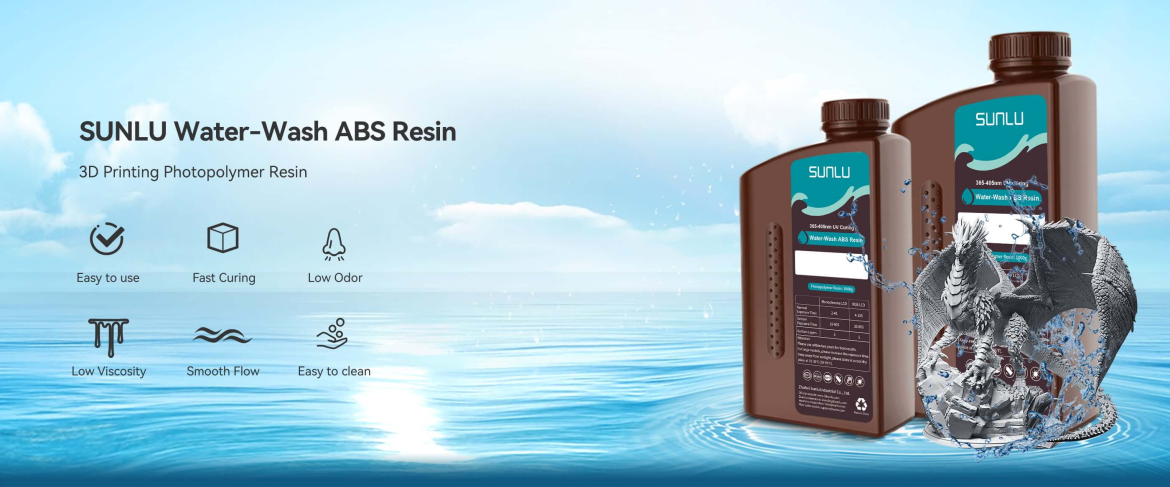
SUNLU Water Wash ABS-Like Resin combines ABS-like toughness and strength with water-based cleaning. SUNLU states that its hydrophilic properties allow models to be cleaned directly with water, while its low-odor formulation is intended to reduce irritating smells during printing.
Understanding Printing Parameters
New users should avoid assuming that one exposure setting works for every printer or resin. Factors such as screen technology, printer model, layer thickness, resin formulation, and operating temperature can influence results. A supplier’s recommended parameters provide a useful starting point, but calibration may still be necessary.
For SUNLU Water Wash ABS-Like Resin, the published parameters specify 5–10 bottom layers. Bottom exposure is listed at 20–80 seconds for color LCD screens and 10–60 seconds for monochrome LCD screens. Regular layer exposure is 4–15 seconds for color LCD and 2–4 seconds for monochrome LCD, with a lifting speed of 60–120 mm/min.
Evaluating Material Performance
For business users, technical specifications provide a more useful basis for material selection than appearance alone. SUNLU Water Wash ABS-Like Resin has a listed tensile strength of 26 MPa, flexural strength of 34 MPa, notched Izod impact strength of 120 J/m, elongation at break of 24%, and Shore hardness of 77. Its listed resin viscosity is 400–800 mPa·s/℃.
These figures help users understand the material’s intended performance characteristics, but they should not replace application-specific testing. A prototype supplier, design studio, educational institution, or small manufacturing operation may have different requirements. Comparing the published properties with the demands of the final application is therefore an important purchasing step.
Where Colored Resin Fits Into a Workflow
Colored resin can reduce the amount of painting or finishing required for certain models and can help teams distinguish components during development or presentation. For beginners, selecting a material with established color options can also make it easier to produce visually consistent batches.
SUNLU Water Wash ABS-Like Resin is offered in grey, dark grey, black, and white, with package weights listed from 333 g through 4,000 g on the product page. The available options allow users to consider both project color requirements and expected material consumption when planning purchases.
Building a Reliable Beginner Workflow
A reliable workflow starts with a manageable test print rather than immediately moving into large production runs. Users can begin by checking printer compatibility, leveling the build platform, selecting the supplier’s recommended settings, and printing a relatively simple model. The resulting part can then be evaluated for adhesion, detail, surface quality, dimensional accuracy, and post-processing behavior.
For businesses, documentation is equally important. Recording resin type, batch information, exposure settings, layer thickness, temperature, washing method, and curing conditions can make successful results easier to reproduce. This becomes particularly useful when several printers or operators are involved in the same production environment.
Moving From First Prints to Practical Production
Once the basic process is understood, beginners can explore different material categories according to their applications. Colored resin may address appearance requirements, while water-washable ABS-like formulations can offer a combination of simplified cleaning and enhanced toughness for suitable functional or structural models.
SUNLU is an integrated enterprise specializing in the research, development, manufacturing, and sales of 3D printing materials and related electronic products. Its Water Wash ABS-Like Resin gives new users an option that combines water-based cleaning, low-odor characteristics, and published mechanical and printing parameters.
Turning Beginner Knowledge Into Better Material Choices
Learning the fundamentals of resin 3D printing gives businesses a stronger foundation for evaluating equipment and materials. The key is to consider the complete workflow, from model preparation and exposure calibration to washing, curing, and final application.
For beginners, colored resin and water-washable formulations can address different practical requirements, but material selection should always follow the project’s technical needs. With documented parameters and application-focused testing, suppliers such as SUNLU can provide material options for users moving from initial experiments toward more repeatable professional workflows.