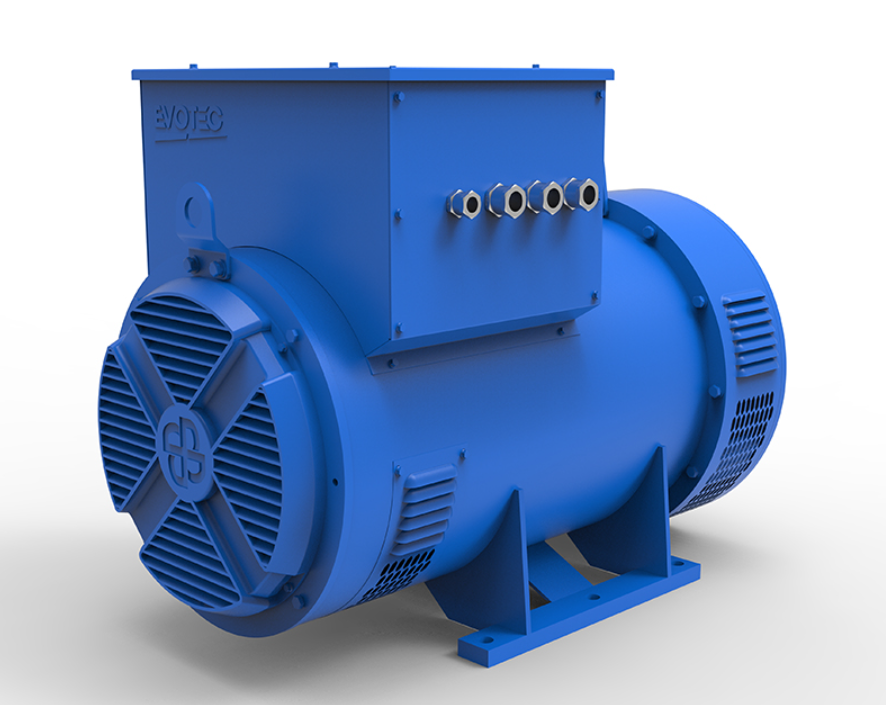
Power generation systems are widely used in industrial equipment, ships, and large-scale facilities where stable electricity supply is required. An alternator is an important component inside a generator system, converting mechanical energy from an engine into electrical energy. Unlike a complete generator set, the alternator focuses on the electricity conversion process. EvoTec Power develops and manufactures alternator products for industrial applications, marine systems, and customized projects. Understanding the working principle helps engineers and buyers select suitable solutions for different operating environments.
Understanding 3 phase alternator Operating Principles in Industrial Applications
A 3 phase alternator works based on electromagnetic induction. When a rotating magnetic field interacts with stationary windings, electrical voltage is generated. In industrial alternators, the rotor creates the magnetic field while the stator contains carefully arranged windings that receive the induced electrical energy. This structure allows continuous power output for equipment that requires stable operation.
The industrial-level implementation of electromagnetic induction includes a rotor magnetic field generated by high-remanence materials cutting through laminated stator windings. Three precisely wound coils are arranged with a 120° electrical angle difference to produce fully symmetrical three-phase voltage with low harmonic distortion. This design helps achieve balanced electrical output for heavy equipment and industrial systems.
The energy transmission process is supported by a brushless excitation system, which includes the main generator, AC exciter, and rotating rectifier module. These components work together to transfer energy efficiently without traditional brushes. A digital AVR controls the excitation current through millisecond-level closed-loop regulation, adjusting output voltage according to system conditions and load changes.
How 3 phase alternator Design Supports Stable Power Output
The performance of an alternator depends on mechanical structure, electrical design, and control technology. The rotor needs accurate dynamic balancing, while the stator winding design affects waveform quality and voltage stability. Proper protection levels and insulation methods are also important factors when alternators operate in industrial environments.
A 3 phase alternator is commonly selected for applications that require three-phase electricity, including industrial machinery, power equipment, and marine systems. Three-phase output provides balanced power distribution and supports equipment that operates continuously under different load conditions. For this reason, alternator design must consider efficiency, response speed, and long-term operating reliability.
EvoTec Power focuses on alternator development with independent research capabilities. They have developed products with compact structural designs that can reduce installation space requirements for equipment manufacturers. Their product range covers industrial alternators, high-voltage alternators, marine alternators, and special customized solutions. They also apply reliable materials and quality management methods during production.
TCM288 Series marine alternator for Vessel Power Systems
Marine power systems require components that can operate under moisture, vibration, and changing environmental conditions. The TCM288 Series marine alternator is designed for ship applications with a power range from 155 to 300 kVA. It supports 380/480V voltage options, 50/60Hz frequency selection, and 4/6 pole configurations. This series is suitable for vessels operating across oceans, seas, and waterways.
The TCM288 Series uses additional marine varnish treatment to improve moisture resistance, mould resistance, and anti-fogging performance. It features a standard SAE interface for easier installation and strong compatibility. The design also includes IP23 protection, multiple excitation options such as self-excitation, auxiliary winding, and PMG, as well as automatic voltage regulator control.
For marine equipment suppliers and ship system integrators, selecting the correct alternator requires attention to electrical characteristics and installation conditions. The TCM288 Series provides voltage regulation accuracy of ±0.5% and a total harmonic distortion rate below 3%. Its sealed bearing structure and high-speed rotor balancing design support stable operation in marine environments.
Industrial Applications and Custom Alternator Development Considerations
Different industries have different requirements for alternator specifications. Industrial equipment manufacturers may focus on compact dimensions, while marine projects often consider environmental protection and installation compatibility. Customized alternator solutions can help match specific mechanical structures, voltage requirements, and operating conditions.
EvoTec Power provides customized development services based on application requirements. They have obtained national design patents and continue improving product structures through research and engineering experience. Their short-structure design approach helps customers optimize equipment layouts while considering manufacturing and installation costs. They also provide a 24-month warranty period for product support.
When selecting an alternator supplier, buyers should evaluate product specifications, manufacturing capability, technical support, and delivery performance. A suitable supplier should understand the complete application environment instead of only focusing on electrical output parameters. This approach helps equipment manufacturers create reliable power systems for industrial and marine projects.
Conclusion
The working principle of a three-phase synchronous alternator combines electromagnetic theory, precision manufacturing, and automatic control technology. From rotor magnetic field generation to AVR voltage regulation, each part influences the final electrical performance. These technologies allow alternators to provide stable power conversion for demanding industrial applications.
As a specialized alternator producer, EvoTec Power continues developing products for different industries, including marine and industrial power systems. Their marine alternator products demonstrate how compact structures, customized designs, and electrical control technologies can support practical engineering needs. The development of three-phase brushless synchronous alternators has made them an important power component for global industrial heavy equipment systems.
