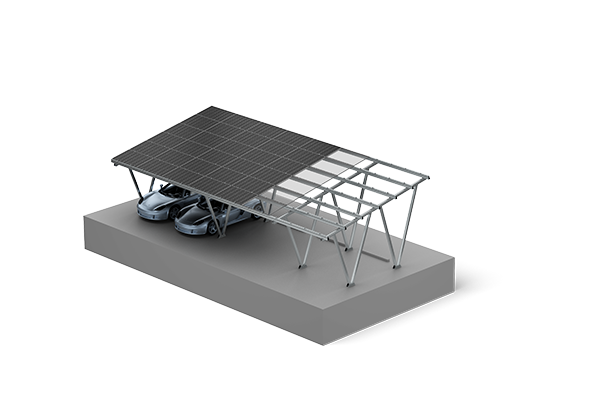
A commercial carport purchase crosses several scopes that are often contracted separately: canopy structure, foundations, modules, drainage, electrical work, lighting, EV charging, civil reinstatement, and traffic management. Undefined interfaces can create expensive gaps even when each individual component appears compliant.
Selecting a solar carport supplier requires evidence of system engineering, configurable products, manufacturing control, project coordination, and post-handover support. Antaisolar‘s aluminum carport portfolio includes W, Y, and Π-shaped arrangements for commercial and charging applications, allowing sourcing criteria to be tested against distinct layouts.
Defining Scope and Design Responsibility
Tender documents should identify who owns survey data, geotechnical investigation, structural calculations, permits, foundations, waterproofing, drainage discharge, electrical equipment, chargers, lighting, utility coordination, pavement repair, commissioning, and as-built records. A responsibility matrix should remain consistent with the commercial price and schedule.
The supplier’s structural design should be based on applicable site-specific wind, snow, seismic, geometric, and foundation design inputs. Calculations should report reactions for each column type and special conditions such as edges, corners, expansion breaks, irregular bays, and attached electrical equipment.
Antaisolar offers three structural forms. The W configuration emphasizes integrity, capacity, stability, flexible installation, and cost-effective; the Y form supports convenient parking and installation; the Π form uses a simple structure with clear parking space. Selection should follow site geometry rather than appearance alone.
Water management must have a named designer. Optional waterproof components, module joints, gutters, downpipes, overflow paths, seals, and pavement drainage should be coordinated as one system. Acceptance can include hose testing, visual inspection, rainfall observation, and closure of leaks before public use.
Assessing Production and Project Execution
Factory capability should be checked through material certificates, dimensional controls, connection samples, fastener records, coating inspection, welding qualifications, pre-assembly, packing plans, and traceable nonconformance closure. The buyer may define witness points for critical interfaces and first-article assemblies.
Modularity can reduce engineering repetition and simplify replacement. A solar carport supplier should still explain how independently configured units connect structurally, electrically, and hydraulically. Expansion, differential settlement, gutter continuity, bonding, and cable crossings can turn nominally separate modules into one interacting system.
Antaisolar allows individual modular units to be configured for customer requirements and easier storage management. Requested logistics documents should include unit-level bills of material, container plans, labels, erection sequences, lifting points, hardware quantities, and allowances for project-specific end or transition bays.
Schedule evaluation should cover design reviews, permits, procurement of long-lead items, production slot, inspection, shipping, civil works, canopy erection, modules, electrical commissioning, and phased parking release. Recovery plans are needed for late foundations, damaged shipments, or unavailable work areas.
Contracting for Safe Long-Term Operation
Vehicle impact, public access, and overhead electrical equipment create operational risks. Bollards, column visibility, minimum clearance, signage, lighting, fire access, cable protection, charger placement, and emergency isolation should be verified before the carport opens.
Reference evidence should show comparable weather, size, drainage, and parking use. Antaisolar lists projects ranging from 20 kW to 500 kW in Latin America and a 50 kW installation in Africa. Owners should seek lessons about construction sequencing and maintenance, not merely photographs.
Handover information should include calculations, material records, foundation data, torque reports, drainage tests, electrical certificates, warranties, cleaning methods, inspection intervals, and replacement part numbers. Service terms should define measurable targets for acknowledgement, diagnosis, parts availability, and restoration.
A capable partner turns interfaces into managed deliverables. When the offered design, factory evidence, logistics, field support, commissioning, and warranty terms trace back to one controlled scope, they can make procurement and lifecycle responsibilities more predictable from contract award through operation.
